Monday, 10 February 2020

Suzette Smart - Textile books workshop

In January Suzette Smart did a return visit to help us make the gorgeous fabric books we saw in her lecture. She started with showing us how to paint bondaweb to give us some interesting shapes to work with.

Someone got a bit carried away during the drying process! 


The next step was to paint "dabs" to make a tree shape and to tear our first shapes up to make them more interesting. 

Smartie pants prize to Saskia who got this piece finished in time for the Feb lecture!

Cutting up calico to make the book base 


Lots of design work going on 


Keeping your cool when your machine has a hissy fit for no reason!
 Lots of concentration - people were so quiet!


 There was the option to machine or hand stitch over the bondaweb shapes.


 Suzette showed us how to make a tree or some thistles with an easy technique


Then adding stitch


 Suzettes work showing how you can add a pocket or text

 Scraps of fabric work well too - most didnt have time to do this on the day


Saskia's with stitch added
 I have worked with Suzette before so she helped me with a more complicated technique using gesso bondaweb and ink. (no that is not a "dead spider" but some lace edging dipped in ink)
 Just bondaweb and stitch can be amazingly effective

Margarets front page


Adding photo

love this piece with just the bondaweb - doesn't it make you itch to stitch it?

 Collaboration is always good. Lorraine making artful use of my left over "dog chewed edging" (it was washed!)


 Janet did her own unique thing
 With her usual colour palette (i spy a cheeky green in there)

building up the detail
Thistles with bondaweb and stitch


 Adding some pieces of fabric


It was a fabulose day and Suzette was a great teacher. She is leading our residential next year (2021) using a refresher of these techniques, adding some more and making a bird house or a box. Lots for everyone to get stuck into and looks to be a whole load of fun!

Elise

Angie Parker - Colour and Weave

This month we had a lecture from Angie (of Angie Parker Textiles) on Colour and Weave.

I have to say a massive well done to Angie - we had a huge technology failure and she managed to deliver a brilliant talk without any slides (which also had her prompts on).

Angie is a rug weaver who comes from a creative family (her mum knits, makes clothes etc)  and her art teacher encouraged Angie in her flair for textiles.  She was taught by the master weaver Susan Foster and in her first show won an award for new designers.  For quite a few years after graduation Angie worked in costume design in order to earn a living.

Here you can see a few of Angies samples - they were so soft to the touch and just beautiful. I dont know how anyone could bear to use them as rugs.

 Angie has lived in India for a while and you can see how much the colours inspired her. She told us that they "get under your skin" (quite literally then there is a festival!)

 These are some of the small sample pieces  - she often does scaled back pieces to try out ideas from  her sketchbook. Angie stressed the importance of having a sketchbook - she will never run out of ideas as there is always more to go back to. 

These smaller pieces are often made up of all sorts of threads not often used in weaving - some had glitter running through them but I am not sure you can see it on the photos.


 This is a sample inspired by Kaffe Fassett made in 1992. She took on board his motto - "if you dont know what colour to add, add another 6"

A lot of the yarns in this rug are made from PET - the plastic that comes from recycled bottles. These rugs are contracted from someone else as Angie doesnt have the specialist equipment needed to make them.  In taking the decision to make such a huge investment Angie asked herself "what is the worst that can happen?" Often it helps you put big decisions into perspective.


This book cover is made from a printed fabric copy of one of Angies weavings. It was so good it looked like a woven piece.  Angie uses collaborations to keep her creative energy going and thought our Branch was a wonderful way to allow us to share ideas, techniques and encouragement.


If you want to see more of Angies work the pictures she was going to show are on her Instagram account. 
Instagram account : angieparkertextiles   Look out for the socks!

Wednesday, 15 January 2020

English paper piecing - Kate Aimson


 A lovely start to the year - the January lecture was all about English Paper Piecing.


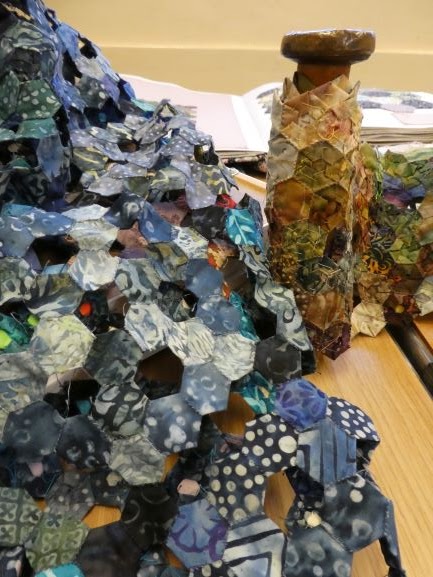
Kate’s first foray into patchwork was as a teenager in the late 1970s. She started to create a large bed cover from scraps of fabric given to her by family members and finally finished it in 2000. As someone who hates to read instructions, she worked out how to do paper piecing from a picture but didn’t realise that the tacking stitches were supposed to go through the paper as well as the fabric. After some trial and error, she created her own method that uses larger seam allowances and retains the tacking. 


Since her teenage beginnings, Kate has learned to experiment with motifs, colours and techniques. She lives in Buxton which is too remote to allow her to attend any formal classes, but she has been disciplined in keeping notes about her ideas. She collects patterns and keeps them in a book with her design ideas and charts. She also maintains a colour diary to show the selection of colours used in each piece of work. Her early work was based on a small number of colours, but she plays games with herself to train her mind to handle larger numbers of colours and is now more adventurous in her colour combinations. She made a deliberate decision not to learn colour theory because she felt it would distract her. Finally, she also creates collage books. These are made from books that contain photographs or images that she likes. She then collects and pastes complementary images from magazines, greetings cards, etc on each page to hide all of the text. The example she showed us was created using a Kaffe Fassett book on interior design. Many of us thought this this was a wonderful idea that we would like to emulate.


Kate has found that there are certain aspects of her work that are fixed: using all cotton fabrics, working in hexagons (now only small ones), hand cutting and stitching, paper piecing with large seam allowances, leaving in the tacking. From this base she then experiments with holes, different ways of combining patterns, joining hexagons with ties, stitched text to embellish her work, reversing her work to show the seams and stitches applique on the reverse, leaving in some coloured papers. Although some of her favourite colours are blues with lime green and Victorian hues, she is also influenced by “abrash” which is the natural variation that comes from working with fabric or threads that have been dyed in different batches, for example in different shades of cream.


Her work is sometimes designed on the go and sometimes planned on isometric paper. She has played with converting Fair Isle knitting charts into designs on the isometric sheets. The result is designs that include holes. She also likes to take her work out into nature and photograph it in a natural setting. One piece of work, “Mermaid’s Pool”, was shipped from Buxton to Tristan da Cunha for her to photograph! She visited this very remote island with her husband on a construction project. During the trip she worked with local children on creating designs. She recorded the whole expedition experience in an 8 metre piece of work that became known as “The Toilet Roll”


This year she says she is going to be working in whites, black and white and combinations with book text and is now preparing for her next expedition which is to the Falkland Islands.

(words and photo supplied by Gail T - thanks)